Bespoke Wedding Management Software Case Study
Cooling Castle Barn: Interactive Wedding Planner
For more than 20 years, Cooling Castle Barn relied on its Interactive Wedding Planner to manage bookings, customer information and the many details involved in organising weddings. As the venue changed, different developers extended the system and adapted it to new requirements.
Probeck was commissioned to replace that ageing, business-critical software with a modern application. The objective was not simply to recreate the old screens, but to preserve useful processes while building a configurable platform for customer planning and administration across the business's two venues.
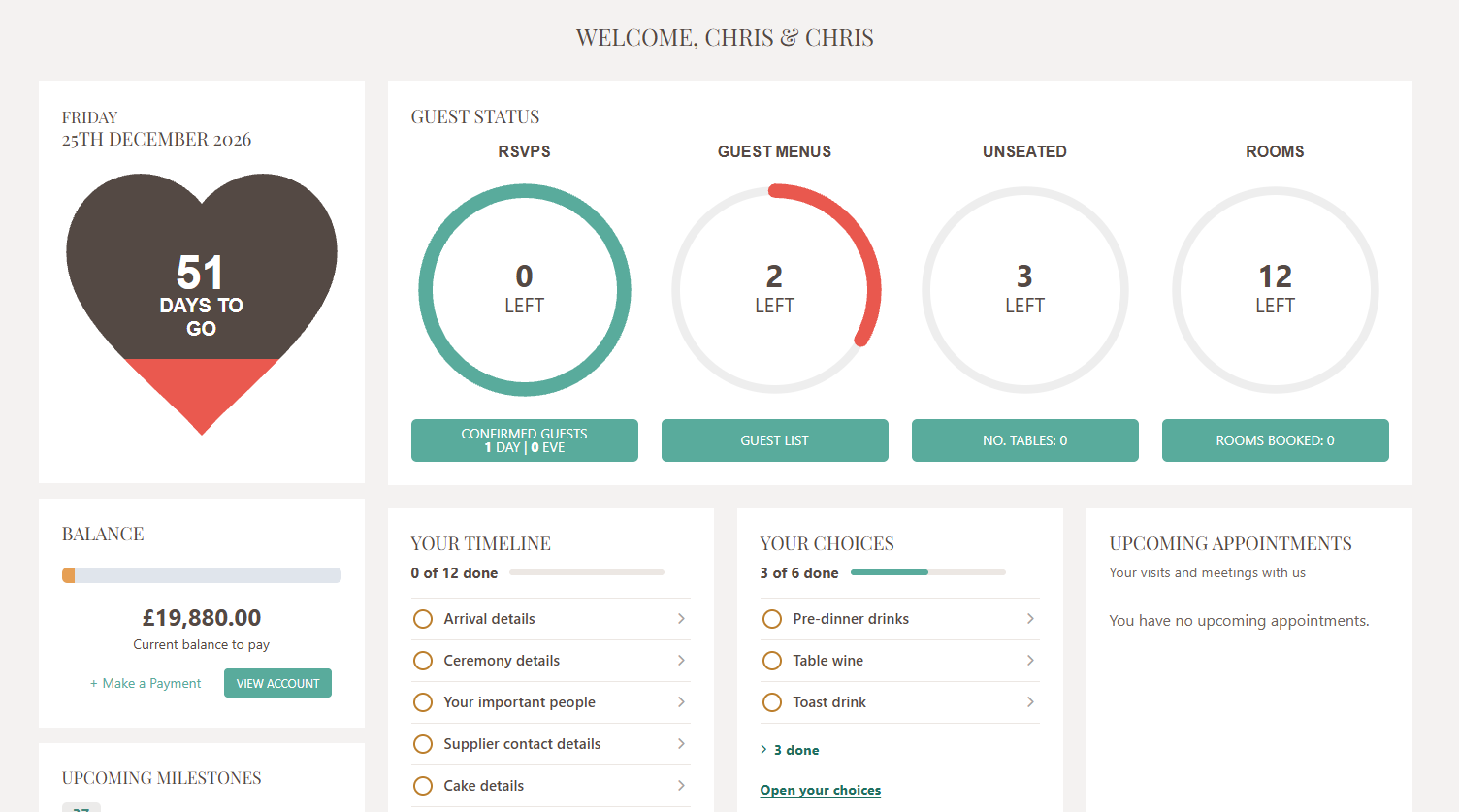
- 20+ years
- Legacy application knowledge considered in the replacement
- One platform
- CRM, weddings, payments, accommodation and reporting
- Two portals
- Purpose-built experiences for staff and couples
- 2 venues
- Managed through one configurable platform
The challenge
Replacing software the business depended on
Replacing a business-critical application is different from starting with a blank sheet.
The original Interactive Wedding Planner had evolved around the way Cooling Castle Barn operated. It had become central to customer administration, wedding planning, financial information and event preparation.
Over time, legacy dependencies and outdated coding approaches restricted which modern PHP versions the application could support. Contributions from different developers had made the codebase harder to maintain, while venue details, prices and processes had become embedded directly within the software.
The replacement needed to preserve valuable operational knowledge without recreating the technical limitations that had accumulated over two decades.
Legacy code
Outdated dependencies and coding approaches limited PHP compatibility and maintainability.
Hardcoded rules
Venue information, packages and prices were embedded rather than configurable.
Complex bookings
Each wedding could involve payments, guests, menus, accommodation and additional services.
Future expansion
A new venue should not require a separate copy of the complete application.
Screenshot note: The interface images in this case study use demonstration records rather than customer booking information.
The solution
One connected wedding management platform
Probeck developed a bespoke web application bringing the business's customer and operational processes together across two venues.
The application combines customer relationship management, bookings, payments, wedding planning, guest information, accommodation and operational reporting. It provides an administration portal for venue staff and a customer portal for couples, both working from the same underlying booking information.
Venue-specific information and processes are configurable rather than scattered through the code. Both current venues use the shared platform while retaining the packages, prices and operating details relevant to each location.
The result is a shared application foundation with distinct experiences for the people administering weddings and the couples planning them.
From enquiry to event
Maintaining continuity through the customer journey
The application acts as a bespoke CRM from the initial lead through to a confirmed booking and the wedding day.
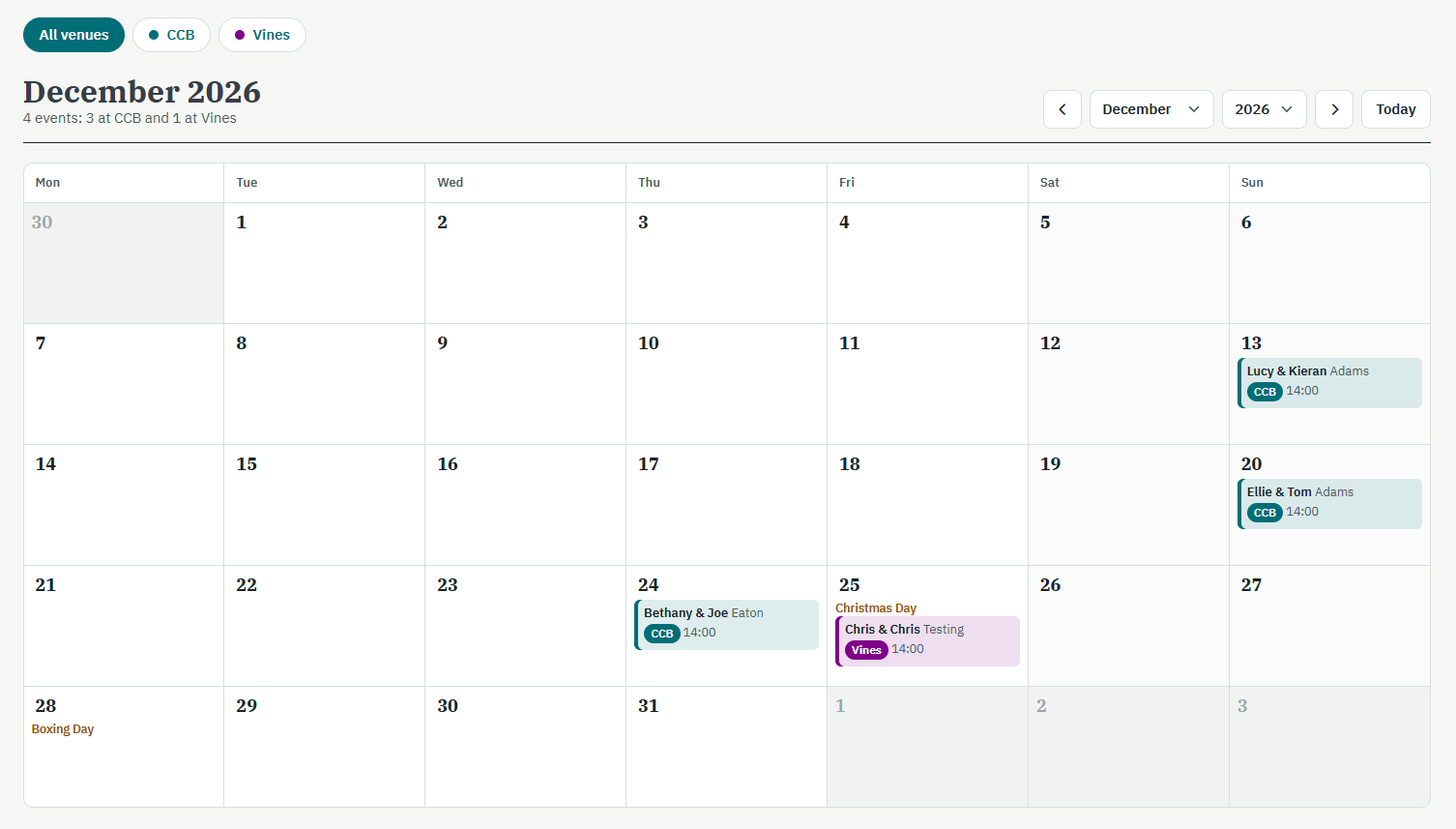
Customer records, enquiries and booking information remain within one system rather than being recreated as the relationship progresses. A central calendar gives staff visibility of upcoming weddings and events, with each entry linked to the relevant customer, financial and planning information.
Secure access controls direct staff and couples to the appropriate environment. Venue administrators can oversee the broader operation, while customers work only with the information and planning tools for their own wedding.
The calendar is therefore more than a diary. It provides a practical route into the complete record for each event.
The customer portal
Helping couples plan their wedding online
The portal gives couples one place to organise important details without relying entirely on separate emails, calls and paperwork.
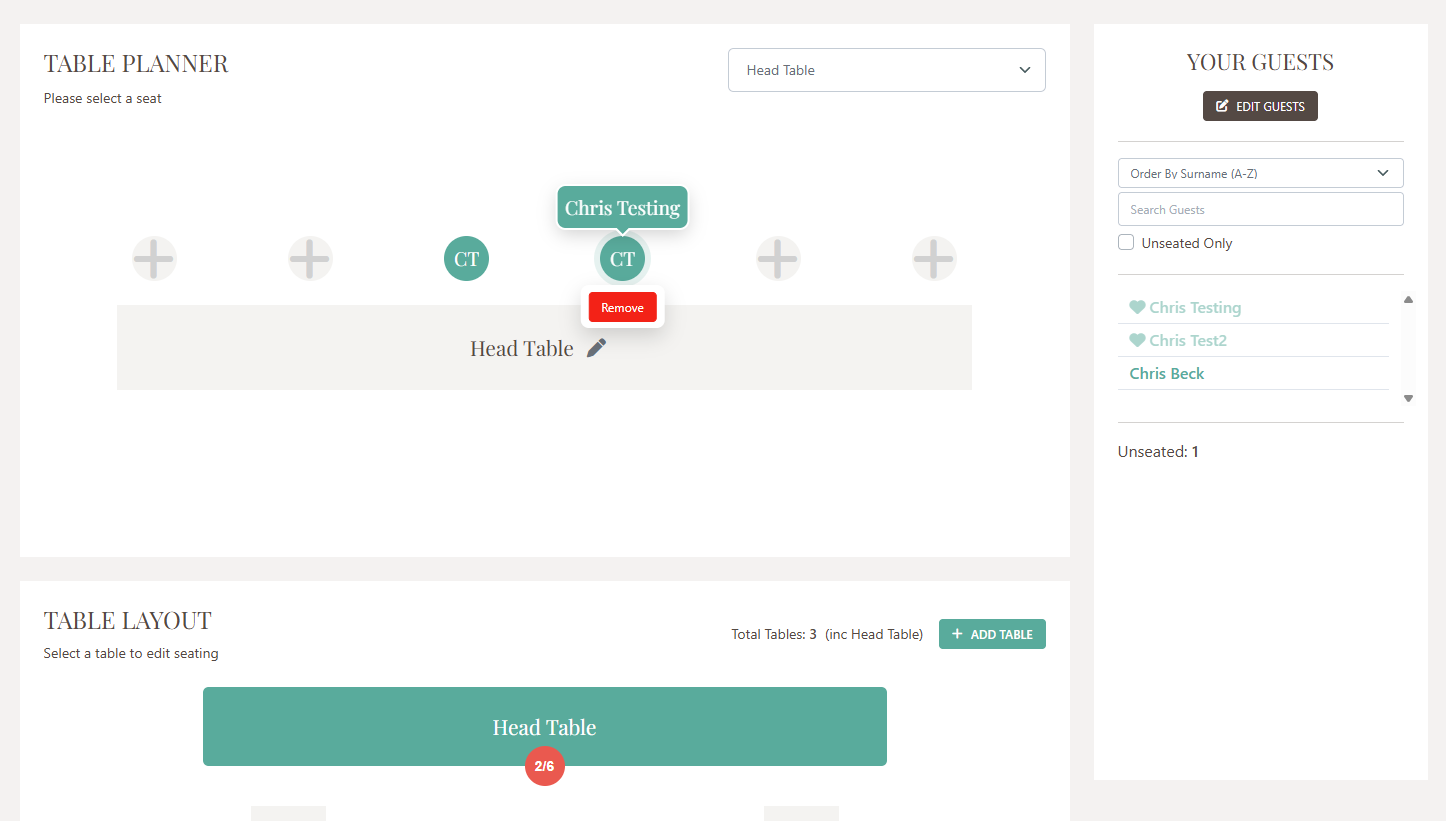
Interactive seating plans
A seating-plan creator supports circular and square tables. Couples can organise guests into tables, while the same information helps venue staff prepare the required room arrangement.
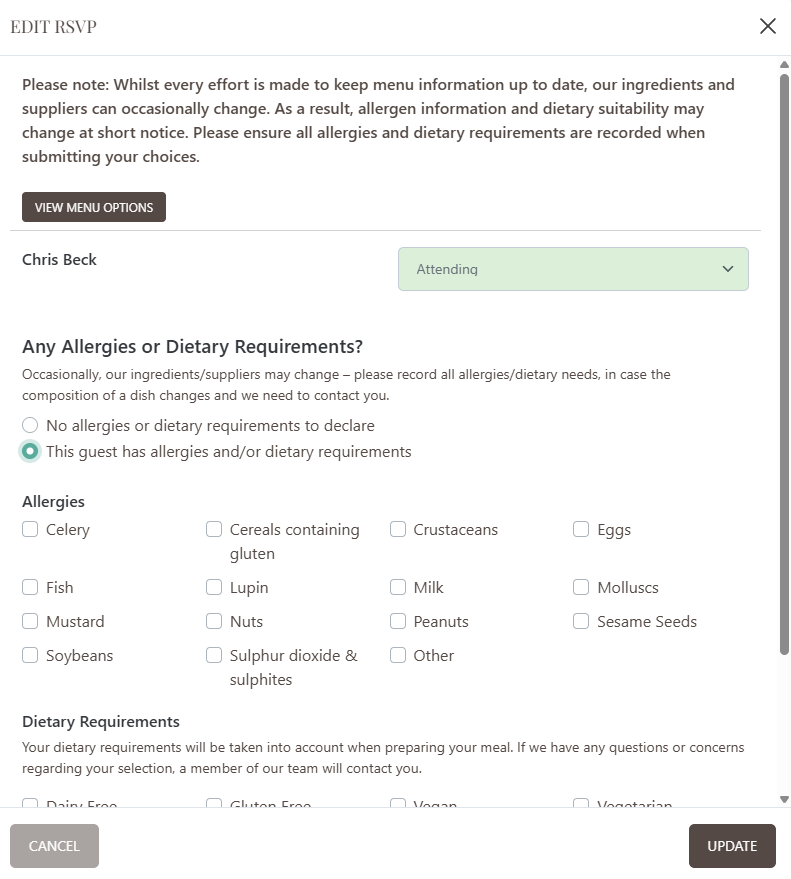
Invitations and RSVPs
Couples can manage guest lists and send invitations by email or SMS. Guests can submit RSVP information online, including allergies and dietary requirements, bringing responses back into the wedding record rather than leaving the couple to collate disconnected messages.
Menus and Your Choices
Menu selections connect guest choices with information needed by catering and operations. A dedicated Your Choices area records preferences and requirements for weddings that do not all follow the same format.
These tools connect the customer's planning experience with the structured information required to deliver the event.
Financial management
Connecting payment information to each wedding
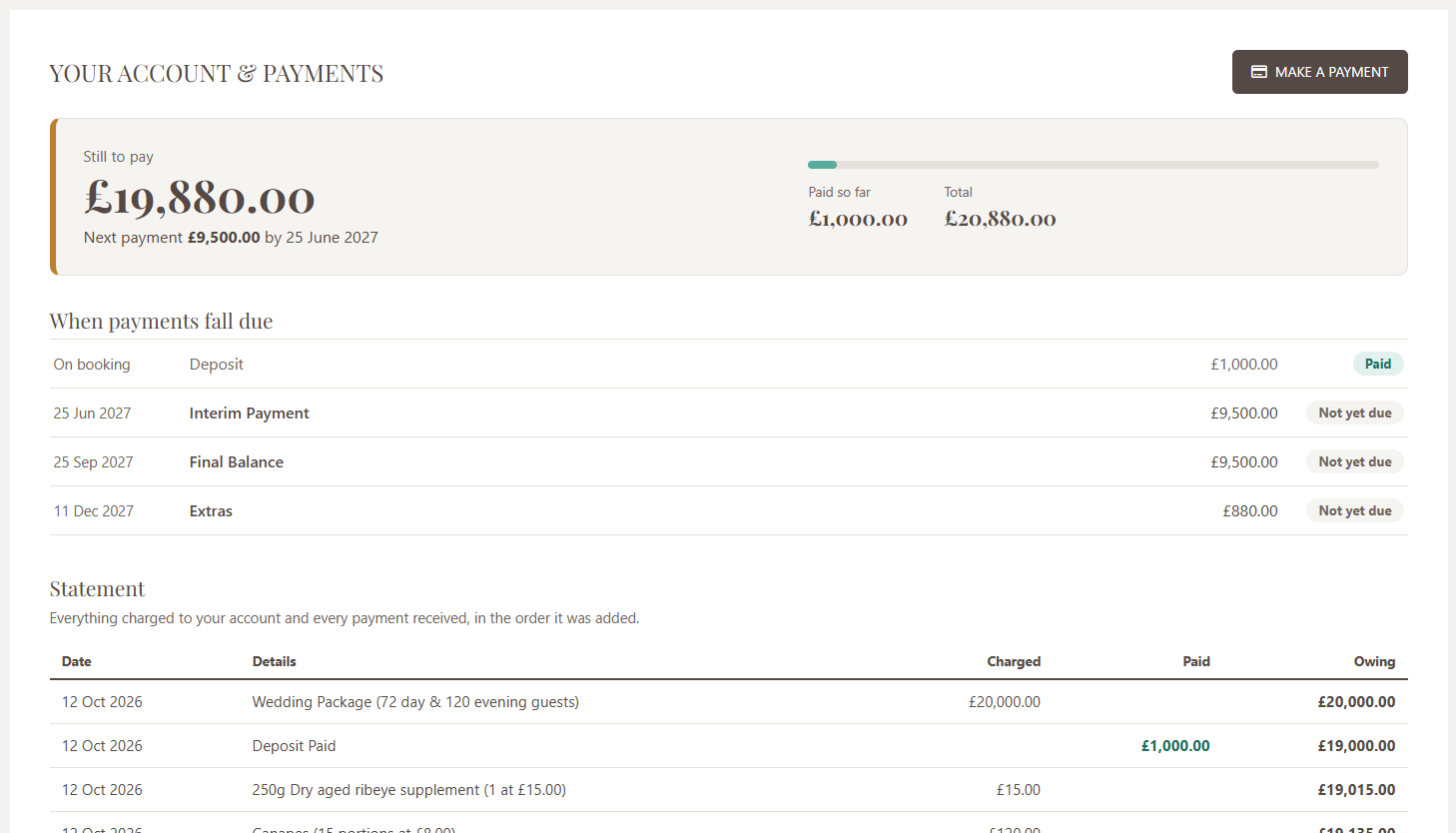
A wedding booking can involve a deposit, scheduled instalments, additional services and final balances.
Through the customer portal, couples can review their wedding costs, payments already received and outstanding amounts. Notifications support scheduled fees, while online payment functionality allows payments to be made through the portal.
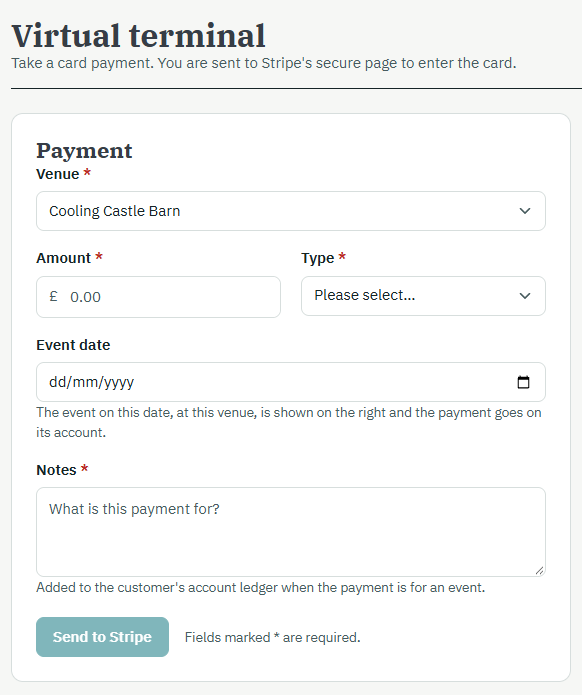
Administrators can manage charges, scheduled amounts, received payments and additional costs against the same booking. A staff virtual terminal sends card payments to Stripe's secure payment page and records the purpose, venue and relevant event information.
The application does not reduce a complex commercial arrangement to one balance. It provides a structured breakdown suited to the stages and additions involved in each booking.
Accommodation
Priority booking for wedding guests
On-site accommodation introduces availability and payment decisions linked to a particular event.
Rooms can be offered to selected wedding guests for a defined priority period. When that period ends, remaining availability can be released for public booking.
Accommodation may be paid for by the couple or booked and paid for by individual guests. Reservation codes provide controlled access to rooms associated with the event.
Including accommodation within the wider platform gives the venue control over availability without operating a disconnected booking process.
Package administration
Replacing hardcoded packages with configuration
The original application's venue packages and prices were difficult to change because important details were hardcoded.
Probeck developed an administrative package creator through which venue staff can configure menu choices, optional extras and prices. Rates can vary by day of the week, allowing Monday to Thursday, Friday, Saturday and Sunday weddings to follow different commercial arrangements.
This gives the business more control when packages change and supports both current venues. Differences between the two locations can be represented through configuration rather than separate copies of the system.
Not every future change becomes a development task, while rules that genuinely require new behaviour can still be developed within the shared platform.
Operational reporting
Turning customer plans into information for the venue
Information only becomes operationally useful when the people delivering the wedding can access it in a suitable form.
Administrative reports can bring together food orders, drink requirements, guest numbers, seating arrangements, table plans and other booking-specific details.
This avoids rebuilding the complete event picture from unrelated documents and messages. The choices entered during planning can support the staff responsible for preparing and running the wedding.
Reporting therefore connects the customer-facing portal to the venue's practical delivery requirements.
Multi-venue operation
Two venues managed through one application
The replacement currently supports two venues without duplicating the complete application.
Configurable venue information, packages and pricing allow the shared software to represent different operational requirements. Staff can review events from both venues in one calendar or filter the view to a particular location.
New functionality can be developed within the common application instead of being recreated for separate venues. This provides a more maintainable model today and leaves room for additional locations if the business expands.
Multi-venue support is therefore active functionality within the current platform, not only a future architectural possibility.
Legacy modernisation
The value of replacing rather than continuing to patch
The project goes beyond updating an old PHP application.
Cooling Castle Barn is moving from software with two decades of accumulated technical limitations to a platform structured around current requirements and future plans. The modern environment, configurable venue data and shared workflows create a foundation for continued maintenance and development.
The application brings customer records, bookings, payments and planning together; gives couples a dedicated online experience; and supports staff through centralised administration and reporting.
These are the intended operational and technical benefits. Any measurable effect on administration time, payment collection or customer experience should be assessed through real use rather than assumed at launch.
Why bespoke software?
Built around established venue processes
Off-the-shelf wedding and event products can be useful, but this requirement extended beyond a typical planning tool.
The application needed to combine Cooling Castle Barn's booking process, payment arrangements, package structure, accommodation rules, customer experience and operational reporting. It also needed to retain practical knowledge developed through 20 years of using bespoke software.
A custom replacement allowed the new architecture to support those processes without carrying forward outdated code or requiring the venue to reshape every workflow around a generic product.
The decision was based on the fit between the software and the business requirement, not on a claim that bespoke development is automatically better.
A connected foundation
Bespoke applications that can develop with the business
A legacy-system replacement became an opportunity to connect the complete wedding journey and two venues within one configurable platform.
The Interactive Wedding Planner covers CRM, event bookings, customer planning, payments, guest communication, accommodation, packages and operational reporting through staff and customer experiences designed around their different responsibilities.
Explore Probeck's Bespoke Application Development, Customer Portals, Booking Systems and Automation & Integrations services for related requirements.
If an ageing business-critical system is becoming difficult to maintain or extend, Probeck can help assess whether continued improvement or a planned replacement is the more suitable route.